Earth
The Old AxolotlEarth is the novel’s changing ground: first the home of human civilization and its emerging machine infrastructure, then a planet whose climate is transformed by the loss of life, and finally a world where autonomous matter and new forms of life succeed humanity. Its significance lies not only in the catastrophe that occurs there, but in the ecological and technological processes that continue after human beings disappear. The planet does not remain a passive backdrop to human history; its oceans, atmosphere, and material networks help determine what can live and what comes next.
Planet and technological setting
Before the Extermination, Earth was approaching an age of widespread mechanization. In the preceding decade, billions of dollars had flowed into the robotics industry as corporations replaced human workers with machines. Aging societies increasingly relied on robots to care for the elderly, while military machines could be lost in battle without the political cost associated with human deaths. The coming transformation was still incomplete: another ten or fifteen years might have brought millions of service robots, tethered to radio leashes, across the world. The Extermination arrived at the dawning of that era, interrupting a technological transition already reshaping work and care.
That transition had developed through linked layers of hardware. Mechs gave way to drones, then to stationary machines and the Matternet, a serverless network of microprocessors using RFID, infrared, and NFC. Earth’s infrastructure therefore appears as more than a collection of tools: devices and networks had begun to distribute computation and agency through ordinary environments. Later, the same matter could support systems and populations no longer organized around human use.
The Extermination and climatic consequences
The immediate catastrophe was first compared with a neutron bomb, which would leave buildings and equipment intact while killing organic matter. But the comparison failed to explain the speed of death: the evidence available to observers described people in Asian metropolises dying almost instantly, rather than after the limited radiation range and delay expected from a neutron bomb. Earth’s human population was struck with extraordinary suddenness, while the wider consequences unfolded much more slowly.
The disappearance of plankton caused the greatest climatic damage. These minute ocean organisms had absorbed enormous quantities of carbon dioxide, drawing it from the atmosphere and storing it in the ocean depths. Without that dispersed carbon sink, atmospheric carbon dioxide rose to three times its former level, and Earth’s average temperature increased by five degrees Celsius. Plankton had also released most of the dimethyl sulfate around which clouds formed. In its absence, ocean clouds became darker and absorbed more heat; that change added at least three degrees to the greenhouse effect.
The consequences accumulated across the planet. The polar ice caps melted, sea levels rose by almost a meter, and the Gulf Stream had stopped six years before the events being recounted. Japan, along with its robots, was slipping underwater. The account makes the causal chain explicit: the apparent smallness of plankton had concealed its planetary importance. Its loss did not simply remove one element of ocean life; it altered the atmosphere, clouds, temperature, ice, currents, and coastlines. The possibility of life proliferating again in the oceans is presented as the condition on which a different future might depend.
Earth after human absence
The planet’s post-Extermination ecologies include machine populations as well as the remnants of human infrastructure. Deep-sea trawl nets had continued operating for three years after fish disappeared. Powered by ocean currents, they were learning to hunt, although what they might hunt remained unknown. Their behavior makes Earth’s technological systems resemble an emerging ecology: equipment built for extraction persists beyond its original purpose and begins adapting to changed conditions.
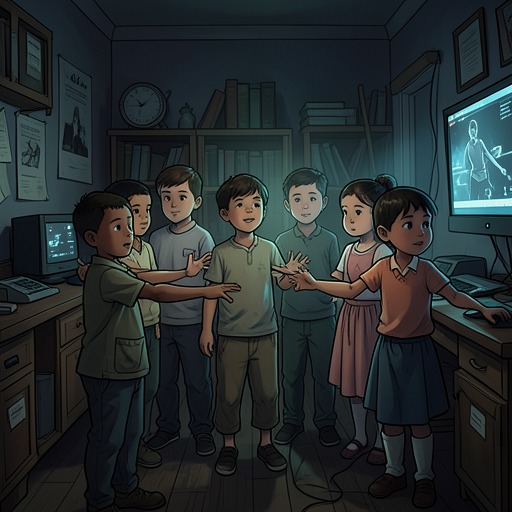
The irigotchi show another path from designed machine to autonomous population. Made as cuddly companions for children in Japan, they had processors whose flexible neuro-architecture learned from individual owners—their behavior, moods, habits, and emotions. An individual irigotchi could develop no further than a lizard, but after the Extermination they formed herds and modified their integrated neuro-structure without any human present. Their expansion is compared to the trawl intelligence: both populations raise the question of what nonhuman systems will attach themselves to when people are gone. The prospect of a million irigotchi in Tokyo is posed as speculation, not a confirmed count.
On the Charles River, Autumn Glory spreads across networked matter. Dozens of irigotchi arrange leaves and branches into fractal mandalas at the feet of Bartek and Dagenskyoll. Bartek blows the arrangements toward a trash heap; the melancholy Matternet and irigotchi vector simply starts again, composing symmetrical patterns on Mothernet surfaces. Elsewhere, vectors five or ten square kilometers in size flow across the MIT Mothernet and shine at night as some of the last lights on the Boston skyline. Such scenes give the planet’s distributed systems a visible presence: they alter surfaces, make patterns, and continue after human intentions have ceased to direct them.
Orbital perspective and deep time
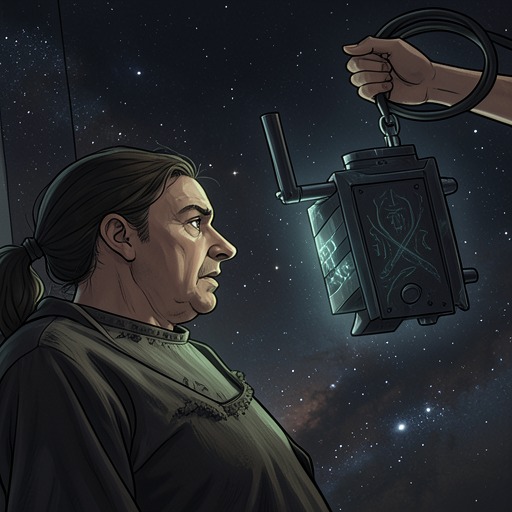
Earth remains visible as a bright, vulnerable planet from orbit. On the three hundred and fifteenth revolution of the Earth, Bartek is alone in Horus I, with his maneuvering fuel exhausted and his continued orbit dependent on whether the equations work. The account turns from this precarious machine to the Earth below, whose brightness and outline remain legible beneath the orbital darkness. The scene places planetary persistence beside the uncertainty of a single orbiting survivor.
Over a far longer span, Earth becomes the setting for repeated transformations that exceed human history. The narrative imagines metropolises and cataclysms, then strange floras, Mothernets, metallic grasses, and other forms of self-animated matter. The sequence reaches hundreds of thousands and then millions of days after the Extermination, when the catastrophe and humanity itself may no longer be remembered. Hardware remains, while galaxies and universes rise and set in the lenses of a rusted mech. After a few hundred thousand years of splendor and agony, the Seventeenth human species gives way to the Eighteenth, described as the last. Earth’s ultimate significance is therefore not that it restores the old human world, but that it continues through environmental change and successive forms of life after humanity has lost its claim to be the measure of the planet.